shewhomust: (guitars)
What can I say? It's vacuous, it's overblown, it is absolutely not my kind of music, but once a year I enjoy it. In moderation: no doubt I'm missing out on stuff I would enjoy, but I don't watch the semi-finals; I don't stay up for the interval performances and the voting; and I'm ambivalent about the way this year's contest even managed to take over Doctor Who. But then, I'm ambivalent about so much in Doctor Who these days, and this isn't a post about that.

Eurovision,then. It's a mark of how (not) seriously I take it, that when the show started I was a bit surprised to find we were in Switzerland - didn't Sweden win? That must have been the year before, but then came the performance of last year's winning song, and I was certain I'd never heard it before in my life. Had we missed last year, for some reason? How fortunate that I keep a diary in hich I wrote that "The favourite won, which I always find disappointing." Sufficiently so to have blanked it completely, apparently.

No promises that I'll still remember this year's winner in a year's time, but it was at least a surprise. Austria was represented by an operatic counter tenor, wearing what looked like his dressing gown as he sailed a paper boat through a monochrome storm, before finally reaching a lighthouse. "Well, that was brave!" I thought. I didn't particularly like it, but I applauded.

Sweden was represented by three Finns singing about the joys of sauna - in Swedish, which is - it says here - the first Swedish-language entry since 1998. The stage set didn't completely do without flashing lights, but its centrepiece was the construction of a wooden sauna. Top marks, too, for the reference to tango with Arja Saijonmaa (which I only picked up from reading the lyrics, and am so glad I did).

I also the UK's hymn to the morning after more than I expected to: the big choral "What the hell just happened?" seemed to be on a different scale to the jaunty "Someone lost a shoe, / I'm still in last night's makeup,/ I'm waking up like, what's this new tattoo?" Overall, though, it wasn't embarrassing and it made me smile. If I am reading the results correctly, it did respectably with the professional juries, but the televoters do not love us. I wonder why?

By the time we reached Albania, who were on last, I was pretty much exhausted: but the costumes and set were so very red they were unmissable. Once I noticed that, and that they seemed to be combining traditional song (in Albanian, I think) and electronica, I ended the evening thinking kindly of them. Honourable mention.

One more thing. Luxembourg's La Poupée Monte Le Son echoes Poupée de cire, poupée de son, with which France Gall won Eurovision for them in 1965. I could go down a rabbit hole comparing the two songs, just how tongue in cheek are Gainsbourg's lyrics (and Gall's delivery), how plausible is Laura Thorn's rejection of doll-like passivity while dressed in an explosion of candy-pink corsetry (I wondered why her tinfoil seemed to belong to a different outfit, but of course all was revealed when she emerged from her corsets to display a tinfoil swimming costume). But let's not. Even the joy of a shout-out to 1965 was slightly upstaged by, of all things, Doctor Who, which managed a shout-out to 1963 - but as I said, this isn't a post about that.
shewhomust: (guitars)
Say what you will about the Eurovision song contest, it does not lose its ability to surprise.

We watched the finals on Saturday; we did not watch the semi-finals, feeling that four hours of Eurovision froth was quite enough for us. In fact, I don't need more than three hours, and went to bed after the songs; [personal profile] durham_rambler is made of sterner stuff, and stayed on through the voting. The favourite won, which I always find disappointing.

Israel, having won their semi-final, came 5th, and I have no idea how to interpret that. The contest is in theory apolitical, but there are few things as political as an institution which makes a point of being apolitical, so it was inevitable that the Israeli presence would cause a fuss. Their initial entry, October Rain was rejected as too political, but a revised version was accepted: it starts with an appeal to "Writer of my symphony" rather than "Writers of the history", and declares that "I'm still broken from this hurricane" instead of "I'm still wet from this october rain", which looks to me like a case of censorship forcing the writer to come up with something better, but what do I know? Inevitably, it allowed Eurovision to claim that it had taken a stand, but did not satisfy the people calling for Israel to be excluded (for what it's worth, I'd rather see an end to arms sales than a cultural boycott, but never mind). What was unexpected was that the Netherlands should manage to get themselves excluded instead (no apparent connection, although the atmosphere can't have helped cool things down, to say the least...).

Some years I become partisan about one particular song, but not this year. On the other hand, there was one piece of staging I found both absolutely dazzling and completely baffling, and would have loved to see again. My plan was to use the official participants listing to revisit that, and a number of other details. Well, up to a point. The list is a wonderful resource (especially as a source of lyrics) but the official videos it offers are, for better or worse, not the competition performances. For those, I'd presumably have to replay the whole show - and that is not going to happen. Some random thoughts, then, which turn out to be even more random than I expected:

The entry I would have liked to see again was Ukraine, who made extensive use of background images wrapped around the two singers, on walls and floor. Their official video is much more restrained, and doesn't really cast any light on the mystery. Instead it plays up the duality of their song Teresa & Maria ("Mother Teresa and Diva Maria" - oh dear!), performed by two solo performers brought together for the occasion, one to deliver the classic Eurovision big ballad, one to rap in counterpoint (I find rapping much improved by being delivered in a Slav language).

On the other hand, Norway's official video does make some connection between the stage performance (for which I was proposing a special I didn't see that coming award) and the lyrics as given in translation:
I was a very fine and beautiful maiden
With an evil stepmother. My mother had died.

She transformed me into a sword and a needle
And sent me off to the King’s estate.

The wrath of my stepmother grew
When all the fine people loved me most.

She gave me the hide of a grey wolf
And forced me to go into the woods alone.

And I would never be whole and good
Before I had drunk of my brother’s blood.


The stage show seemed to depict a ship in a storm at sea: there was water everywhere. But the video suggests a wild storm whipping up a peaceful lake, around a witchy central figure (Ireland also entered a witch, so perhaps witches are having a moment). The band's name, Gåte, means 'riddle' (according to Wikipedia), which figures.

The song features a nyckelharpa, which makes Norway runners up in the most obscure instrument category. The winners, though, were Estonia, who had something which I think is a talharpa. Like Ukraine, they also went for two bands appearing as one, with a song - I discover from the lyrics - about a drugs bust. Also, with so many performers wearing nothing but a few sequins, you have to applaud a band of blokes in big full-length black coats.

On the night, I interpreted Armenia's entry as another piece of dualism, the woman in a miniskirt version of traditional dress singing her 'modern' pop at - rather than to - the male instrumentalist who played in a more traditional style. Their video brings them both together in an over-the-top version of a tourist board advertisement. You could compare it, as a tongue-in-cheek version of traditional (peasant) life, with Croatia's official video in which Baby Lasagne (probably the best band name - sorry, Finland's Windows95man) plays the country boy leaving the farm. I coveted Baby Lasagne's waistcoat, not the one in the video, but the one he wears for rehearsals and performance, a fancy embroidered version of traditional national costume as saved for best.

Finally: since I've talked about the inscrutability of some of the staging, I should add that if there were a prize for most transparent staging, which there isn't, it would go to the UK. With the subtlety for which we are famous, we apparently recognised that Eurovision is a very gay event, and put Tom of Finland in charge of the choreography. We came in 18th, beating Estonia, who finished twentieth, which is what usually happens to my favourites.
shewhomust: (Default)
We have been working steadily through the latest series of Digging for Britain, and have at last been introduced to the object on which the camera lingers so lovingly in the opening title sequence: a three-dimensional geometrical shape, hollow, metal, pierced and decorated with knobs which seem to glow turquoise under the lights. I had no idea what it was, what it is for, or even how big it is...

It turns out to be the star find of the Norton Disney History and Archaeology Group in Lincolnshire, and it is a Roman (or Gallo-Roman or Romano-Celtic) dodecahedron. What is it for? Nobody knows.

Digging for Britain went on at great length about how incredibly rare these are, which made me feel better about not having known what it was. But by "incredibly rare" they mean that this brings the total found in Britain to 33; there are about 120 throughout the northern corner of the Roman Empire (Atlas Obscure has a map). Not to disparage this find, which is a lovely thing, and does appear to be in beautiful condition: finding it would make anyone's year. But there are several along the Roman Wall (there's one at Corbridge).

The Smithsonian magazine article is headlined: Another Mysterious Roman Dodecahedron Has Been Unearthed in England, as if their readers would know all about the things. You can even buy replicas (try Etsy). So yes, maybe I should have known this all along. Anyway, I'm glad to have learned about it now.
shewhomust: (Default)
The Carol Evening last Sunday went well. The mulled wine that I had left to mature after breakfast was pronounced the best yet by several different people: so, for the record, Banrock Station shiraz mataro and heavy on the (fresh root) ginger. A slightly altered seating arrangement meant that GirlBear was in the middle of the musicians and had a slightly different view to her usual, and when I grabbed the seat by the door (so I could slip out after Down in Yon Forest to put mince pies in the oven and refresh the mulled wine) I was just at her shoulder and could enjoy this. Some of the usual singers had carelessly absented themselves, and one had to withdraw at the last minute with covid: we have been doing this for 40 years, so we are always conscious of absent friends. But A is still finding copies of the songbook in which she has not yet corrected the spelling and punctuation. At the Winter Songs concert [personal profile] boybear had asked me how old was Il est né, and I had looked it up. The initial response, of course, is "We learned it at school," but now we were able to add a proper provenance, that it was first published in a nineteenth century collection of Christmas songs from Lorraine (which doesn't actually go much further than "Nobody knows!") As we say each year: always different, always the same!

On Monday we celebrated [personal profile] durham_rambler's mother's centenary: for many years, trying to allocated our Christmas visits among three sets of parents, we would spend her birthay with her, a week ahead of Christmas Day (I'm not sure she ever found this an entirely adequate substitute for spending Christmas with them, but better than nothing): this year we met with those members of the family not detained by work (his brother, sister-in-law and nieces) at the cemetery where [personal profile] durham_rambler's parents' ashes are interred on the margins of the memorial to his illustrious relative; after which we adjourned again to the home of Younger Niece, who had prepared a lunch which would remind us of her grandmother (she had not recognised [personal profile] durham_rambler's suggestion of banana custard, and prouced a very elegant cream, in the manner of a fancy restaurant deconstructing a familiar dish).

In the evening we went with the Bears to Unity Folk Club, which is where we learned to sing Deck us all with Boston Charlie. C. startled me by singing A Sailor Courted a Farmer’s Daughter (what Mainly Norfolk describes as Dominic Behan's version): why was this song which no-one else seemed to recognise so very familiar to me? (Mainly Norfolk blames Robin Hall and Jimmie Macgregor, which means I knew it very well more than 50 years ago). It's a very supportive club, and wedid actually take up our turns on the singaround: since we had had some (political) parodies of Christmas carols, I, with the help of [personal profile] boybear sang Hark the jelly babies sing..., and [personal profile] durham_rambler with the help of the assembled company, sang The Man who Waters the Workers' Beer and Alex Glasgow's Socialist ABC.

What did we do on Tuesday and Wednesday? A little light shopping: guided by GirlBear, we went to Kentish Town, to the Phoenicia Food Hall and the Owl Bookshop, and then to the Wellcome Collection, whose gift shop filled the last few gaps in my Christmas present list. We had planned to meet [personal profile] boybear at the East West restaurant which serves various Indian inflected pizzas; I wasn't sure about this, but the Bears recommended it. Anyway, it was closed, so we crossed the road and ate Thai instead, which was fine. Back at our flat, [personal profile] durham_rambler and I caught up with an episode of Only Connect which delighted me by including a reference to Peter Dickinson in a sequence of fictional detectives (his was the difficult first one, which you aren't supposed to recognise, and I didn't, until we reached 'the second son of the fifteenth Duke of Denver' whom none of the contestants identified).

Wednesday was mainly packing. Lunch with Bears, an evening of tapas with [personal profile] helenraven in Southwark. High points, catching up with [personal profile] helenraven, fishy rice, excellent wine (Montsant,adjacent to Priorat); low point, spilling a glass of said wine over myself (and the table, but luckily no-one else).

And yesterday we left London via Waltham Cross, where we had coffee with A. Now we are in Ely, with D. and [personal profile] valydiarosada. Not going anywhere right now, just lazing with crosswords and internet, watching the wild muntjac deer browsing in the garden, being looked after by our hosts.
shewhomust: (mamoulian)
On Saturday Channel 4 devoted nearly two hours of prime time to a documentary which promised to shed new light on the mystery of the Princes in the Tower: on Sunday we watched it. I was sceptical, but I wasn't going to miss it - see the title of this post. Philippa Langley, described as "the writer who located the final resting place of Richard III" has apparently discovered new documentary evidence, and enlists Rob Rinder, wearing his criminal barrister's hat (his other career in daytime tv is never mentioned) to assess it critically.

Since the trailer shows Philippa Langley murmuring "I think they survived..." I don't think it's a spoiler to say that my immediate expectation - that this was going to be about the pretenders known as Lambert Simnel and Perkin Warbeck - was correct. With the aid of an army of volunteers across Europe, she had apparently unearthed four significant documents. I say "apparently" because I don't actually know how new this material is: it was presented as shattering and world-changing, but so were things that I already knew - that's how Saturday night television works. They are, if I am remembering correctly: an entry in the accounts of Emperor Maximilian for weapons to support 'the son of Edward IV' to claim his throne; an account from the court of Maximilian of the Emperor recognising Richard by certain birthmarks; a document, complete with royal seal, in which Richard promises to pay 30,000 florins to Duke Albert of Saxony after gaining the English throne; and a first person account (in old Dutch) by Richard of his escape and (very circuitous) travels.

In order to examine these, Langley and Rinder had to visit several European libraries, and other places associated with the story. This provided a generous helping of eye-candy. I was particularly impressed with somewhere I think was Mechelen, where Margaret of York had her court (I didn't recognise the name, but the internet suggests a French name, Malines, which does ring a faint bell): worth a visit... The camera also lingered lovingly over each of the documents in turn, and that, too, was a pleasure, picking out words and phrases (often obligingly highlighted, which always makes it easier).

So there was much to enjoy. But.

Great emphasis was placed on establishing that the documents were genuine, but it was assumed throughout that if they were genuine, they must be true: lying had apparently not been invented in the fifteenth century. If the seal says 'Richard, King of England, then the person who affixed that seal must be the rightful king of England, even if he has not yet taken possession of his throne - somehow, the seal has come into being. If the accounts show that money has been spent on weapons, then the cause in which those weapons were carried must be a just one. To introduce some last minute jeopardy, Rob Rinder consults Janina Ramirez, and she points out that the first person narrative is a touch too good to be true: it reads like something concocted to present its audience with the sort of exciting story they want to hear. He is shaken by this, but he gets another expert to look at the document, and pronounce it genuinely of the time and place of its purported creation, so faith is re-established.

Philippa Langley is partisan, and I sympathise: I can see why she believes the narrative she builds on these documents. But I don't believe that Rinder doesn't see the flaw, and I am insulted that he thinks I won't notice it either. I didn't expect much from this programme in the way of depth or historical background; if anything, I expected less than there was. But I was left speechless at its brazen disregard of the big hole in the middle of its case.
shewhomust: (mamoulian)
We watched the new season of Good Omens -

We try not to use Amazon if we can help it, but they had something that [personal profile] durham_rambler wanted, and when he bought it, they offered him free postage and a trial month of Amazon Prime. Which we used, of course, to watch Good Omens.

What I thought of it is complicated, so I won't go into that here. Instead, here's a question. In the final episode, the (very junior) angel Muriel discovers books. Did I really hear them say something like "Books. Like people, only portable."

It's such a great line, I've been trying to track down the exact wording, and authorship (can I assume script is by Neil Gaiman unless otherwise stated?) but without success. Ask a search engine about 'books people portable' and it will offer to sell you books. Add the information that this is a quotation from Good Omens, and it will try to sell you books like Good Omens. As if. I found a whole compilation of clips of Muriel being adorable, but it doesn't include this line. I'd think I dreamed it, but it's too good.

The internet has a massive amound of information about Good Omens, but I have just dragged myself out of that rabbit hole, and I'm not going to risk going in again. So if anyone knows the answer, please tell!
shewhomust: (mamoulian)
[...] have many such examples, and one amongst the rest of a baker in Ferrara that thought he was composed of butter, and durst not sit in the sun, or come near the fire for fear of being melted:

Robert Burton, The Anatomy of Melancholy


I am grateful to Countdown's Susie Dent, whose 'origins of words' spot this afternoon pointed me to the source of these words, which I know as the preamble to Dr. Dim And Dr. Strange (on YouTube). (After this, the two texts diverge, but I'm guessing that this is a matter of editing.)

Now I wonder why I've never managed to find it before (oh, I have searched). Or even why I didn't guess the source.
shewhomust: (guitars)
This line from the Moldovan entry pretty much summarises what I look for in the Eurovision song contest, and this year's edition offered plenty of it. There were other themes, too. Commentator Graham Norton described the show as "the great Italian shirt-shortage of 2022," and he had a point, there were indeed a number of bare-chested males on display. In the interests of balance, though, I should also note that Spain managed to secure third place by sending their (female) singer out skirtless (and yes, removing her jacket in the course of the song). There were several very emotional men, a category in which I include the UK entry, unmemorable but apparently not embarrassing. Estonia was a cowboy, and Iceland were cowgirls. The obligatory WTF moment was provided by Norway's contribution Give That Wolf A Banana, undermined by my strong suspicion that they were Doing It On Purpose. Here's the beginning of their biography:
Subwoolfer, the biggest band in the galaxy, got together 4.5 billion years ago on their home planet… the Moon.

Since then, Keith and Jim have conquered the music scene on every other planet, making them the most successful pop group ever… so they tell us.


Back to the folklore... )

We had hoped that F and C would join us for the evening, as we are compatible in matters Eurovisual: but C messaged to say that F had caught Covid, so that didn't happen. The pandemic may be over, but people who are being relatively cautious are still catching the virus, and the potential long-term effects are bad enough that I find this worrying. Get well soon, F!
shewhomust: (Default)
A week ago I posted that I was virtually ready for Christmas, barring one or two small tasks which should not present any problem: well, I think we can all guess how that went, can't we?

The last of the packages were in the post the day before the deadline, but at least one of them has not yet arrived (in London, admittedly, which is where services are most likely to be interrupted). Food shopping went to plan. Glasses frames were tried on, and a pair chosen: I am not in love with them, but they are fine - the hardest thing was deciding whether to have the pair that I liked better with a mask, or the ones that I liked better without. And, talking of shopping, we have bought a car - or rather, we have signed a contract on an electric car, when it becomes available in the spring (they are not currently building them fast enough to meet the demand). All [personal profile] durham_rambler wants for Christmas Easter...

We have sung a small but beautifully curated selection of carols from the Bears' repertoire; and more carols with the Melrose Quartet, not to mention a dozen 'name that tune' challenges from their ongoing 'one song to the tune of another' project (but in their case the one song is always Rudolph the Red-nosed Reindeer. This wasn't one they did at the concert, but it's a good indication of how it works:


An entire day went on visiting and being visited and virtually visiting (a Zoom call with S. who had cancelled her long-anticipated Christmas trip to Greece, and was remarkable philosophical about it). And I have cooked and washed up and cooked and washed up again, and done a little actual work in amidst it all. Reading the round-ups of the year's best television, we have watched all the wrong things: the Countdown finals, the University Challenge Christmas specials - oh, and I enjoyed re-watching Desperately Seeking Susan.

Any of these things could have been a post of its own: it's all good, but I don't know where the time goes. The point at which I thought yes, this is authentic Christmas was last night, on the sofa with a mug of instant coffee, watching Morecambe and Wise... This afternoon we hung up the Christmas cards, which is our token piece of Christmas decorating. And now it's time to do battle with the leftovers.

Obsessions

Nov. 16th, 2021 06:01 pm
shewhomust: (puffin)
I have admitted before that although we are apending our evenings in front of the television, mostly we are not watching the much-praised dramas (unless they are based on the work of Ann Cleeves). We watch a lot of Pointless with Alexander Armstrong and Richard Osman; we dip into Richard Osman's House of Games; and we have just watched the three installments of Alexander Armstrong's trip to Iceland. You will think that I am obsessed with these two presenters, and I will reply that no, it is the television which is obsessed with them.

My true obsession, and the reason I am posting about this, appears in that film about Iceland, in which Xander visits Heimaey:


Speed through to about 25 minutes in, just after the break, for the visit to the wildlife rescue center, and the puffins - Including the briefest blink-and-you've-missed-it film of puffins zipping about in the water.

Then they cut away to fuss over the Beluga whales. Some people have no taste.
shewhomust: (mamoulian)
We are relying heavily on television for our evening entertainment these days; and since for some reason, neither of us is drawn to the much-praised dramas, and we are not in the least interested in sport, our viewing can be a bit random. But then, the same is true of what's on offer. I don't know why the BBC thought that now was the time for a rerun of its 2008 version of The 39 Steps - and come to that, I don't know why the BBC thought in 2008 that the world needed a new version of The 39 Steps. But a couple of years ago I read the book, slowly and carefully, as the pub quiz's Book of the Moment, and I was curious to see how much of the book I read what could survive in a 21st century version.

Quite a lot of the framework is still there: the eve of the Great War, the plot against Britain, Hannay dropped into the action by Scudder, the agent who knows what is going on but is killed before he can inform those who need to know, Hannay's flight to Scotland, wanted for Scudder's murder - and a lot of running to and fro across the Scottish landscape...

The adaptation gives Hannay a motive for his flight to Scotland: he is following Scudder's intelligence that this is where the enemy have their stronghold. In the book he needs to hide out until the time is right, and selects the southwest of Scotland for its empty spaces on the map (his knowledge of veldcraft, apparently, makes this a better prospect than the anonymity of the city). The film places its hero under very conventional time pressure: he leaves his flat unprepared, and later learns that a crucial event will takes place within two days... The book reverses that convention, in that the hero must remain at liberty for as long as possible, which allows him plenty of opportunities to admire that landscape, and to encounter the people who populate it.

The adaptation isn't short of admirable landscapes, and is meticulous in offering authentic Scottish locations, even for those parts of the action which do not take place in Scotland (in the process removing the already thin justification for those 39 steps themselves). Even so, to reach Stirling castle, it has to bypass the area in which the book is set. This seems a waste, when Buchan has described it in such detail that it can be followed on a map (and the National Library of Scotland has the map in question). There's nothing weong with the filmed scenery, but it lacks the magic of the book - which is interesting, because I wouldn't have thought of recommending Buchan for the beauty of his descriptions ...

Buchan had gone to some trouble, too, to populate his landscape: not just with the minor parts, like the travellers on the train who provide the fugitive with cover, but a gallery of individuals distinctive enough to provide the chapters with intriguing headings: the adventure of the literary innkeeper, the adventure of the spectacled roadman. Hannay encounters a variety of working people, from the herdsman's wife who gives him a bed on his first night in Scotland to the roadmender whom he first impersonates and with whom he later finds refuge (not to mention the milkman!). Only the adventure of the radical candidate, in which Hannay falls in with a young man of more or less his own class, survives into the film.

It survives, and the outline of the adventure is retained, but the flavour is much changed: the 'candidate' of the book is a cheerful young man whose political allegiance is not that of his author, who willingly allies himself with Hannay for his own reasons. In the film he is almost simple-minded, easily deceived by Hannay - and he has a sister. It was probably inevitable that a 2008 version would feel the need for a romantic interest, and that she would be a strong and capable woman. If I were more invested in the book John Buchan wrote, I might object to this in principle, but as things stand, I was more irritated by the character's insistence that she is a suffragette (she's almost certainly a suffragist and resents that demeaning diminutive). Much of the twisty-turny plotting of her narrative is not to my taste, but then, I feel the same way about much of the twisty-turny plotting of the original novel -

That's a good point to cut this short, I think. The film was a painless entertainment for a quiet evening; I was very far from loving the book. Nonetheless, not for the first time, I conclude that "the book is better."
shewhomust: (guitars)
Which sounds like a contradiction in terms: but I don't think it was just me. Possibly it was an effect of covid. The audience was as crazy as ever, and didn't look any more spaced out: it was one of a series of experimental and highly-monitored events, and there my have been fewer people there than usual (I think this was mentioned) but I wouldn't have guessed. The Icelandic entry was represented by a film of their rehearsal performance, since one of the band had tested positive and they were self-isolating in their hotel: [personal profile] durham_rambler voted for them regardless, though this may in part have been out of appreciation for their entry last year, which was odd and quirky and deserved to win. This year's entry was pleasant enough, but I don't come to the Eurovision Song Contest for "pleasant enough", I come for those moments of bewilderment, of WTF? of "did I just see what I think I saw?" and no, didn't get many of those this year.

Perhaps the Russian entry - the staging, not the song. The format is not a fair test of a song, because it usually takes a few repetitions to hook me - but there's usually at least one song I can recall as long as the start of the voting. Not this year. There was a lot of rap-inflected, rhythmic stuff, which may go some way to explain it. The Russian entry (Russian Woman, though the singer comes from Tadjikistan) alternated this sort of chanting with something anthemic (is it, in fact, a national anthem? if not, someone should claim it!). The official video is only a faint echo of the staged production, in which the singer in her red boiler suit emerges, not from a mere oversized dress but from a rigid construction, as if she were hatching from a giant matrioushka doll. She doesn't seem to have won many votes for her impeccable feminist message; nor did the Netherlands for their Birth of a New Age, which I thought more melodic than most - and gave brownie points for being partly in Sranan Tongo, a language of Suriname.

I liked the Ukrainian entry, too, which combines Ukrainian folklore and electronics, it says here. Again, the official video goes beyond the stage setting, which I preferred: its unreality had charm, while the realism of the video falls into the uncanny valley - for me, at any rate.

I didn't stay up for the voting, but [personal profile] durham_rambler did, and was able to tell me, when he came to bed, that Italy, the favourite, had won, that France had come second (by channeling Edith Piaf) and that the UK had scored our traditiopnal nul points. All very sober and sensible...
shewhomust: (Default)
This was not going to be the next thing I posted about; there are several other posts queuing up in my head, waiting to be written. But what can I say? This one has jumped the queue, and this is what you get.

I'm one of the very few people in Britain who has never seen Bake Off. I didn't watch Sewing Bee, or The Great Pottery Throw Down. But finally they came up with a twist of the formula that did appeal to me, and I have been watching All That Glitters. The exhibition space of Birmingham Scool of Jewellery serves as a huge and palatial workshop in which a group of working jewellers - initially eight, working down to three - are given a series of tasks by two stars of the profession (I had never heard of them, but why would I have?).

Each week there are two challenges, the first to design an item which could become a best-selller, the second to produce a bespoke piece for a "client" who provides the show with a human interest story (the drag queen who is about to open a solo show, the couple who lost their engagement ring in a burglary). Each week one contestant is sent home, one has their bespoke piece chosen by the client, and one is named Jeweller of the Week. There is, in other words, far too much palaver, and unnecessary jeopardy, and of course everything has to be done against the clock - and comedian Katherine Ryan hosts, and works very hard to ensure that the audience isn't bored. She is nowhere near as irritating as this sounds.

There was never any risk that I would be bored: I was perectly happy to watch these very skilled people making pretty things, working precious metals, setting stones, twisting wire, cutting and twisting and setting, and only occasionally melting something they didn't mean to. I enjoyed hearing them explain the technical choices they were making - and I enjoyed seeing the pretty things that resulted.

ETA 1: I looked at the layout of the early episodes and wondered whether they had been filmed in lockdown: those very well-spaced workstations in that huge echoing space... But no, because a subsequent episode began with the explanation that filming had been suspended ar the advent of lockdown, and they had only now found a way to resume.

ETA 2: This is, I think, another pleasure for which I should thank Lucy Mangan. Her recommendations don't always work for me (the first episode of The Pursuit of Love is an hour I won't get back) but without her my viewing would be even deeper into its rut!
shewhomust: (mamoulian)
In the virtual absence of a social life, I continue to entertain myself by watching a lot of Pointless and by reading a lot: sometimes these two things converge.

A little while ago, a round on Pointless required contestants to complete proverbs and saying about love (this post was not intended as a Saint Valentine's special, but if you'd like to view it in that light, be my guest). None of them was able to supply the 'best' (lowest scoring) answer on the board, it is not possible to love and be --, and neither could host Alexander Armstrong. No, agreed Richard Osman, I'd never heard it either.

Wait a minute, isn't he supposed to be a crime writer? And to read a lot of crime fiction? How can he not know Josephine Tey's To Love and be Wise?


Reminded of the book, I wanted to re-read it; and re-reading it, I enjoyed it so much that I wanted to post something here to say so. But part of that enjoyment was precisely the pleasure of the re-read, of seeing how thoroughly the author prepares the resolution of her mystery. It would be unkind to spoiler the first-time reader of what genuinely is a mystery, that "more or less" on the cover notwithstanding.

Alan Grant, Tey's recurring detective, is called in to investigate the disappearance of a young man has inserted himself into the community of artistic incomers in an English country village, and then vanished. The publisher's "more or less" reflects the absence of a body, but also the witty and light-hearted atmosphere of the book: it is posible that something terrible has takrn place, but it is also possible that it hasn't. The cover is not an accurate depiction of any one scene but it is not a misrepresentaation either: a shoe fished from the river is produced as a clue, a ballet dancer offers as a reasonable alibi that a sequence of steps occurred to him so he tried them out, just there, beside the river (the characterisation is, I admit, on the broad side at times).

What I would like to be talking about is that this book was published in 1950, and yet it does this thing (and also several other things, but this thing in particular) which it would be a massive spoiler to reveal. Which makes this post a bit pointless.
shewhomust: (Default)
We haven't been following Channel 5's Secret Scotland with Susan Calman: I am resistant those documentaries which give the ompression they actually find their subject matter rather boring, but hopes that if they move fast enough - and maybe put a celebrity between the viewer and the topic - no-one will notice. Or perhaps I'm just jealous of all these people who are still able to travel when I am told not to ... But D. pointed out that one episode was visiting Bute, where we spent a weekend together in the summer, so we made an exception.

It was pretty much as expected. There was only time to see one thing on Bute, which was - inevitably - Mount Stuart House. It was, admittedly, absolutely stunning, and I see why D. was so disappointed that it was closed (see above, jealous). Then Susan was off to Kilmartin Glen (here are some standing stones, here's a burial site, now I'm going to cast a copper axe-head...).

The programme did have one surprise, though, quite early on. Susan visits Inverary, to indulge an interest in change ringing at the bell tower there, and is greeted by Ringing Master Ruth Marshall. Wasn't the daughter of our bell-ringing friends called Ruth? Obligingly, this Ruth had brought in her parents to help her demonstrate, and a little careful back-and-forth rewinding enabled us to freeze the one fleeting glimpse of parents hauling on ropes, and it was indeed T and M.

I was quite disproportionately pleased at this sign of life going on.
shewhomust: (Default)
This week's offering in the film club series was The Band Wagon, a 1953 musical in which Fred Astaire's dancing comes very close to being overshadowed by Comden and Green's script.

Is such a thing possible? It has some classic Astaire dances - though I prefer the unexpected partnership with (real-life, apparently) shoeshine man Leroy Daniels in Shine on your shoes (fuller story here, but ad-heavy website or digested version, easier on the eyes) to the romantic stroll in Central Park with Cyd Charisse, or indeed the grand finale of the 'jazz ballet' Girl Hunt (because, and I'm sorry to repeat myself, but we have seen this in Singing in the Rain, and personally I find it a better fit for Gene Kelly's style). But when I think of The Band Wagon I think of it as an ensemble piece. It's about the pleasure of hanging out with Oscare Levant and Nanette Fabray as the husband and wife creative team into which Comden and Green (who were a purely creative pairing) transform themselves, and about the whole Hey, kids, why don't we do the show right here in the barn! spirit of the theatre.

It's a commonplace of the genre, of course, that if your musical is about the production of a musical, then any song or dance that can't be fitted into the narrative (I stop short of calling it a plot) of the outer musical can be palmed off as a number within the inner musical, which isn't obliged to make sense. The Band Wagon stretches this convention further than most. For one thing, it actually offers us a storyline for the show-within-a-show: in fact, it offers not one but two stories. There is the frothy comedy as pitched by the Martons, in which Tony (Astaire) plays a writer of children's books who moonlights as a crime writer, but feels guilty about it - and at a stretch you could link the 'triplets' and 'private eye' numbers to this framework, though perhaps not the 'Louisiana Hayride'. It goes further, and applies the same logic to the title: the movie we are watching is called The Band Wagon because the show the characters are putting on is called The Band Wagon. But why is that show called The Band Wagon? Ah, that's the mystery, especially as the title appears to be equally applicable to the light-hearted song-and-dance show and the melodramatic Faustian shocker.

Why, I wonder, did they not call the film after the big ensemble number, That's Entertainment? That title wasn't taken, and it picks up on the central argument of the story: what is entertainment? Can theatrical prodigy Jeffrey Cordova, currently starring in his own hit production of Oedipus Rex bring his magic touch to the Martons light-hearted musical comedy? Can the thinly disguised Fred Astaire dance with ballerina Gabrielle Gerard; and she wih him? Why yes, says Jack Buchanan's Cordova, there is no chasm between high and low culture, it's all entertainment. I love this assertion, and the big disappointment of the film is that it doesn't deliver on it: Gabrielle Gerard comes fown from her pointes, Cordova's production is a spectacular flop at the out-of-town try-outs, and the show can only be rescued by reverting to the original plan. It isn't clear whether the Faust versinn is bad in itself (though there are hints that this is the case) or whether leaving the audience traumatised is a mark that it has, on its own terms, succeeded. But either way, the assertion is unmistakable: this is not entertainment.

Om. well, you can't have everything.
shewhomust: (Default)
There seem to be more 'classic' movies on my (Freeview) television these days: I don't know if it's a result of filling the space left by the difficulty of making new programmes in these restricted days, but any silver lining is welcome. And so we watched A Star is Born on BBC4's Thursday Night Film Club - the 1954 Judy Garland and James Mason version. I've seen it before, but not recently: I was taken by surprise at the announcement that we were being shown the restored version - but the restoration dates to 1983. I don't know how far that accounts for my feeling at times that I had never seen this before, while some scenes were vividly familiar; perhaps it's just an artefact of my erratic memory.

I assume we all know the story: fading star Norman Main discovers, nurtures, falls in love with talented Esther Blodgett: as she achieves stardom, he falls from it. What I remembered, in addition to this outline, are three scenes: one early in the relationship, in which he eavesdrops as she sings with the band in a late night session; one midpoint when she returns from a day at the studio and attempts to divert hom by performing the big production number she has been working on - and of course, the final shot, the moment when she returns to the stage and claims the name of 'Mrs Norman Main', the moment when she is born as a star.

That selection encapsulates the film pretty well, I think: I had remembered above all the trajectory of the relationship between two people, but I had retained - most clearly of all, in fact - the scene of domestic domestic life which is also a (not unkind) mockery of Hollywood pretensions. I had completely forgotten all the film's big production numbers (I remembered the song Born in a Trunk, but not the routine that accompanied it) but this scene which ridicules them had stayed with me. I can't claim too much credit, though, because I had remembered it for what it says about the couple, not as part of a critique of Hollywood: one this second viewing, that is the aspect of the film which really stood out for me, but it struck me as something new, something which I had previously either not noticed or not remembered.

For whatever reason, what really stood out for me this time round was the extent to which this is a film about Hollywood - and I kept seeing resemblances to another film about Hollywood, made a couple of years earlier, and which could also have been titled A Star is Born: one in which the girl we see coming to stardom is Kathy Selden. Granted, seeing patterns is something I am prone to, but even so...

So am I imagining this, or is something going on here? )

I want to love Norman Main. I'm pretty sure I did first time round, and James Mason continues to be wonderful. But the rôle hasn't aged well. Yes, alcoholism is a disease, and the man can't help it; he doesn't get any pleasure out of behaving badly, his pain is tangible. But, but, but. He hits down: he disrupts the charity show by a band who are less successful than he is, he insults the publicist assigned to him (and yes, eventually the man justifies his disklike, but which is chicken and which egg?); he finds it unbearable that his wife is more successful than he is (a success he has brought into being, but I do see that that doesn't help), that she is working and he isn't; he can't even make an eatable sandwich...

Of course, this is Vicki Lester's tragedy as much as it is Norman Main's. I may have been slow coming to this conclusion: I've resisted allowing awareness of Judy Garland's own story to colour my reaction to the fiction. And what really cristalises this may just be a question of my personal musical taste. But Esther Blodgett's high point as a creative artist, as far as I'm concerned, is that first scene I remembered, the one in which she and the band and relaxing after a performance, trying something new, and Esther - no, dammit, Judy Garland - sings The Man That Got Away. It's stunning, and I say that as someone who is not usually a fan of the torch song.


The process of becoming a star removes this intense, personal art, and substitutes the anodyne, pleasantly wistful It's a New World. It isn't enough for Esther Blodgett to be eclipsed by Vicki Lester, to become a star Vicki Lester must be remade as Mrs Norman Main. There is no way this is going to end well.

ETA:* Unless I am confusing this with a sequence in On the Town in which the characters go 'on the town', from night club to night club, and we catch the end of a succession of chorus acts, identical except for costume ...
shewhomust: (Default)
Autumn is here; the evenings are dark, and often so are the days, overcast and rainy. The mornings are still light, thank goodness, we still wake up to daylight, just about. Enjoy it while it lasts.

The new university year has started, a little later in Durham than elsewhere, and we have not (yet, thankfully) seen the sort of outbreaks of infection among the students that our neighbours in Newcastle have had. But [personal profile] durham_rambler has been digging into the local figures, and thinks that infections in the city are many times higher than those in the rest of the county. A friend who lives in Barnard Castle asks, subtly "Are you being very good about observing the regulations?" and I would love to respond Would you like to meet up? Instead I replied "It's not that we are being good, but we are being cautious..."

New term or no, the Botanic Gardens are still closed, and the head gardener continues to mail out a daily picture. Last week we passed Day 200 (ouch!). Day 203's picture is a view of the car park.

With the new series of Only Connect, Monday is once again quiz night on television - and yes, life is quiet enough that this is a real pleasure. University Challenge sails blithely on with a series which must have been recorded in its entirety before March's lockdown, which I suppose allows the competition to be completed before the contestants are distracted by exaams - but meant that on Mondays Jeremy Paxman told potential entrants for the next series that their Students' Union has details of how to enter. Only Connect was delayed until they had worked out how to slide perspex screens between the three members of each team. Countdown has simply increased the space between Susie Dent and the Dictionary Corner guest. Is either of these precautions sufficient? I don't know, but I hope so, because I am really pleased to see them back.

I have posted before - because life is very repetitive around here - about the pros and cons of lockdown television, with specific reference to Staged, and what I said about that is what I am saying now about the return of the quizzes: "What I am disproportionately grateful for is the recognition that we don't have to wait for the promised new dawn, the 'on the other side' to be creative, that we can still make entertainment, drama or comedy with what resources lockdown allows us. Hey kids, why don't we so the show right here in the barn?"

Not just television: GirlBear sent me this slideshow from the weekend school she and [personal profile] boybear had attended. Look! Live music! Irritatingly short snatches of live music, but all the same, music (including wind instruments):

shewhomust: (puffin)
  • The milk thief has struck again: our milk has been lifted for the second time within a week. Other people have been the target on other days, and the people across the road (who one day lost five of their eight pints) are pretty fed up. They have installed a security camera, which managed to see nothing this morning, neither the delivery nor the heist.


  • Not everyone in Ajo likes the new paint job on their lighthouse, and I have some sympathy with them: it's certainly striking. But not much, because, as a quick search on Flickr makes clear it wasn't all that exciting before!


  • We watch more television in lockdown than we did before, but it's mostly quizzes and the odd documentary: we aren't drawn to all the must-see drama that gets so much praise. Last Friday, though, the BBC (for reasons of its own: it was Rosh Hashanah? because it was directed by Alan Parker?) showed Jack Rosenthal's The Evacuees, and we caught up with that over the weekend. It draws on Rosenthal's own childhood experiences, and one result is that it's a bit episodic. The boys are sent away from home and eventually they return: here are some things that happened in between, and here are some people they happened to. Sometimes I wanted footnotes: for example, the schoolmaster escorts his class from Manchester to Blackpool, and then leads them along the street, knocking on doors and asking people to take them in, and, really? And where are the girls? (Aren't there any girls?) There's a curious double-vision of the past, too, viewing 1940 through the lens of 1975 - and the joy of a young Maureen Lipman.


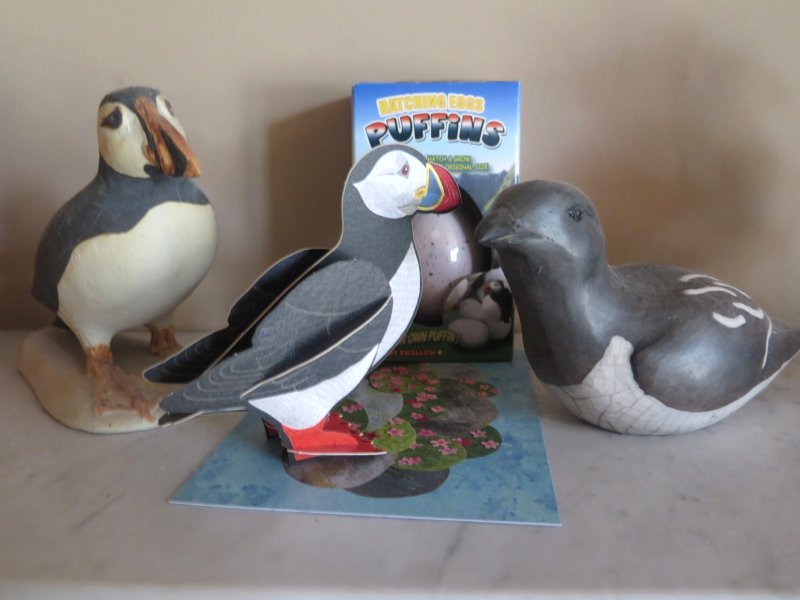
  • GirlBear posted me a puffin:


    She bought it at the Owl Bookshop in Kentish Town, and she sent it to me, and I pressed it out and slotted it together and there it is. With a little help from its friends it just about stands up!

    Next I shall have to see if I can hatch the puffin egg D. brought me from Iceland.


  • This afternoon we did the sort of shopping where you go to one shop after another and do a number of errands: this has become very unusual for us! [personal profile] durham_rambler was keen to try the new weigh shop which has opened next door to his favourite beer shop, and to stock up on light bulbs from Wilko (that's about as opposite as two kinds of shop can get.

Watching

Jun. 14th, 2020 11:52 am
shewhomust: (Default)
Last night's TV was Goodbye Christopher Robin. I went into it with a vague sense that it had not been well reviewed, and so without great expectations: on that basis I was not disappointed, it was fine. In fact, Mark Kermode seems to have liked it, but I'm glad I didn't know that ahead of time. But then, my enjoyment of narrative based on a true story is always tempered by the itch to know exactly how much is true. Screenwriter Frank Cottrell Boyce paints a childhood of what amounts to parental neglect, and he names the book on which the film is based; Christopher Milne paints a gentler picture in his memoir The Enchanted Places - and while yes, he would, wouldn't he? I'm inclined to accept at least a degree of nuance from his account. My view of the film's truthfulness may be coloured by its opening, a scene in 1941 in which Christopher's parents receive a telegram from the front containing bad news. This is not untrue, but it invites a false perspective on the entire film.

We have also watched three of the six episodes of Staged in which David Tennant and Michael Sheen pay versions of themselves as actors cast in Six Characters in Search of an Author thwarted by lockdown and going through the motions of rehearsing from home (as recommended by Lucy Mangan). It's funny, and meta, and comes in handy bite-sized chunks. I am happy to be entertained by stuff that was produced before the pandemic: I read people who now flinch away from scenes of crowds, or dancing, or social embraces, but no, that doesn't bother me. That was then, this is now. What I am disproportionately grateful for is the recognition that we don't have to wait for the promised new dawn, the 'on the other side' to be creative, that we can still make entertainment, drama or comedy with what resources lockdown allows us. Hey kids, why don't we do the show right here in the barn?

January 2026

S M T W T F S
    123
45678910
11121314151617
18192021222324
25262728293031

Syndicate

RSS Atom

Most Popular Tags

Style Credit

Expand Cut Tags

No cut tags
Page generated Jan. 6th, 2026 05:17 pm
Powered by Dreamwidth Studios