On the road again
Oct. 14th, 2006 09:18 pm![[personal profile]](https://www.dreamwidth.org/img/silk/identity/user.png) shewhomust
shewhomustFurther disconnected impressions from that first day's long drive:
 At first you only notice that the churches are bright and freshly painted, gleaming white among the many-coloured houses. Gradually you realise that they don't just look new, they are new, with their shiny metal roofs not yet tarnished. There is building going on everywhere, new houses springing up among the old: but it's disconcerting to see new churches being built. One settlement consisted of just two low blocks of flats, but it too had a brand new church.
- In the small towns, housing is drab concrete blocks of flats; but the little houses in the villages are painted in a variety of colours, and not just subtle pastel shades, but strong bright colours that leave an after-burn on the eye. Red, orange, green, blue, yellow, ochre:
- a building that looked like a motel, two blocks facing each other, one canary yellow with a powder blue trim, the other with the shades reversed (this particular combination of yellow and blue seemed to be popular on new blocks)
- a house painted vivid orange, overgrown with a bright red creeper
- all shades of green, from deepest forest green to cool peppermint
- a house isolated among the fields, salmon pink with a white fence
I couldn't tell whether the choice of colours followed some hidden convention, or whether it was pure self-expression. 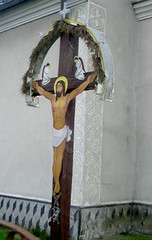 There are crucifixes everywhere, all along the road, every few yards. The one in the picture is one of a pair at the gate of a church, but only because, as I said, I am self-conscious about screeching to a halt, leaping out of the car and photographing someone's garden. And throughout the region they all seem to come from the same supplier: a half to two-thirds life size figure on sheet metal, the crucified Christ with various attendants (angels or doves or garlands), his paintwork in various stats of repair, or repainted with more or less attention to detail.
- As we drove out of Cluj - with some difficulty: leaving towns was always the real challenge to our navigational skills - through the village of Apahida, we saw a row of informal stalls. At each, a man or woman waited beside piles of polished red cabbages, peppers, tomatoes, aubergines, apples, giant radishes - two, three, four different items at each stall. Coming into the mountains, roadside commerce took the form of teenagers with big baskets of walnuts and girolles, waiting by the many level crossings where the traffic was obliged to slow down.


