![[personal profile]](https://www.dreamwidth.org/img/silk/identity/user.png)
Not forgetting E.Nesbit
Oct. 27th, 2025 06:14 pmI came late to the Eight Days of Diana Wynne Jones podcast. What can I say? I am a twentieth century person, and have never really engaged with podcasts (perhaps now I have my new phone...?). So I didn't hear about Eight Days of Diana until it won a Hugo. But I would totally have listened to it if I had, even without that recommendation. And if I had been there from the start, I might have leapt into the discussion of Wilkin's Tooth (which, by a piece of sleight of hand, is the second episode) to say "Never mind Arthur Ransome!" who had been referenced in the context of children being left to play outside unsupervised all day. "What about E. Nesbit?" Can you discuss fantasy literature for children without stumbling across her influence? Probably not, although the reason I see her most clearly in Wilkin's Tooth is not the magic but the mundane: 'Own Back Limited' seems so precisely a sceme the Bastable children might have come up with. Calmgrove agrees about the parallel and takes it further.
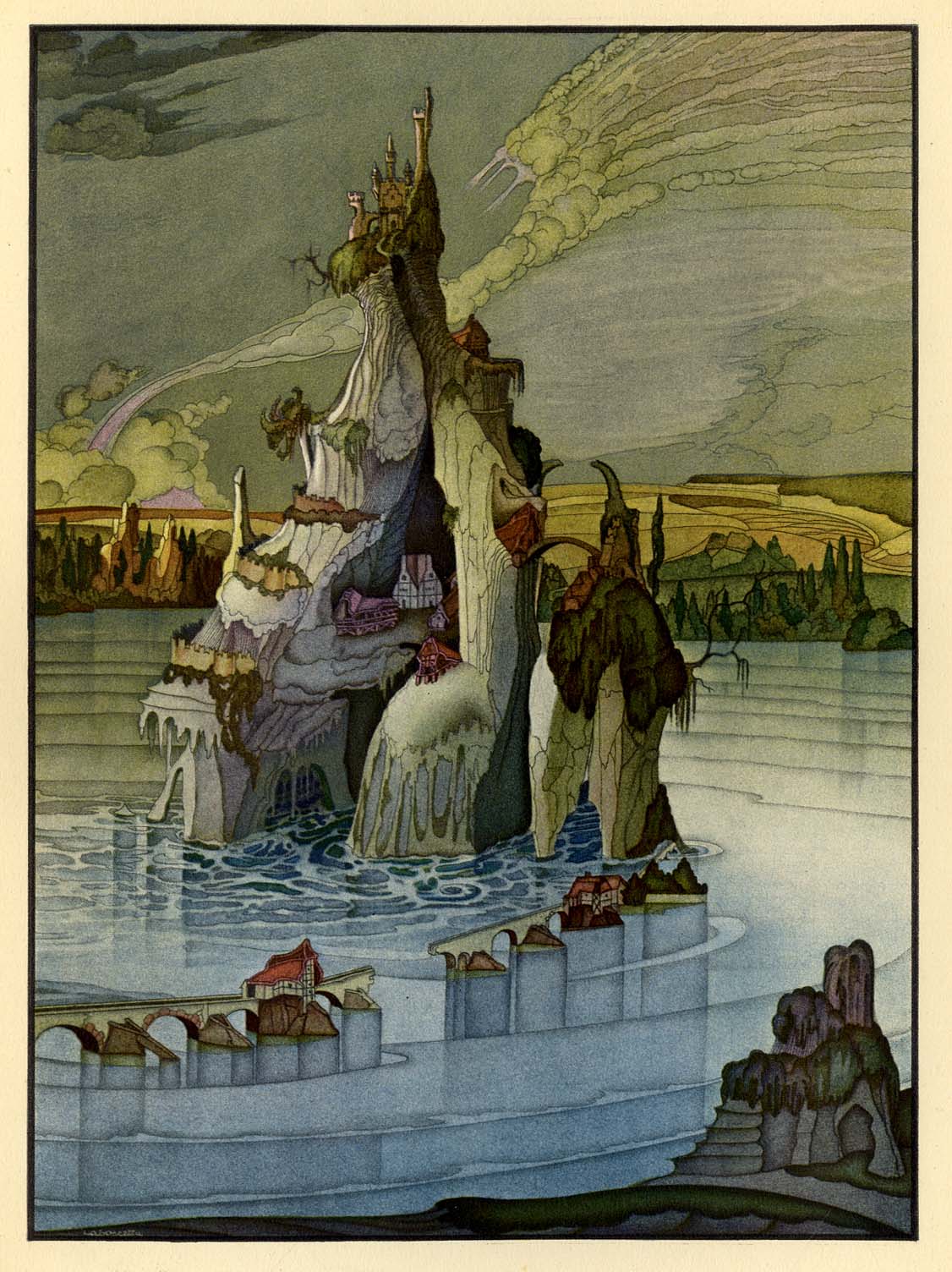
Fortuitously, as I was thinking these thoughts, The Enchanted Castle came to the top of the diary pile. It's a tattered paperback copy which I bought in a charity shop in Berwick one midsummer: I knew I had read it before, but I didn't know whether I owned a copy (and I still don't know: if I do, it's on the top shelf and not easily accessible). And it had a very splendid cover: this illustration by Mario Laboccetta for The Tales of Hoffman. (With thanks to John Coulthart's essay on the art of Mario Laboccetta for identifying the original function of this image, and for some other samples from the same book). Splendid, yes; appropriate, absolutely not: Nesbit's castle is behind a hedge in the English countryside, not rising precipitously from the sea. My immediate reaction was that it would make a perfect cover for Sandra Unerman's Spellhaven, about which I have previously posted: poking around the internet reminds me that the cover of that book features the Mont Saint Michel, which is also perfect...
Having judged the cover in its own right, what about the book? (available from Project Gutenberg) As I said, I knew I had read it before, and I thought I remembered it. There's an early scene in which the three children, having found their way through that hedge to what they declare to be an enchanted castle, awaken the enchanted princess they meet there - who very rapidly confesses that she is not really a princess. This was vivid in my memory, where it had solidified into: This is one of those 'magic or not?' books in which the music is not real. But I had completely forgotten that what impels Mabel to own up is that she has become invisible: really, truly and despite her own incredulity, magically invisible. In fact, not only does The Enchanted Castle contain genuine magic, it contains an awful lot of it; the castle eventually turns out to be largely built from magic.
That said, there is something mundane about many of the magical incidents in the book: Mabel's embarrassing invisibility, Jimmy's transformation into an adult (disagreeable enough that I hope this is not really his adult self), the audience improvised from broomsticks, bolsters, umbrellas and hats who come to terrifying life (one scene from the book that I did remember accurately). The problems the characters face are not the dangers of another world, but the embarrassments of concealing the irruption of magic into their daily life. Perhaps this contributed to my false memory?
But there's a point at which the magic shifts gear: and what's more, Nesbit points out that this is happening. Gerald finds himself invisible in the grounds of the castle at night:
In these moonlit gardens, the book starts to move towards its conclusion, in which all concerned attain their hearts' desire. First Gerald and then others see marble statues come to life: starting with a full-size dinosaur, but later encompassing any number of classical deities - Hebe herself, and "Aphrodite Urania, the dearest lady in the world, with a voice like mother's at those moments when you love her most..." and Eros, "a really nice boy, as the girls instantly agreed." This has the flavour of those chapters in which Mary Poppins has an evening out - so much so that I had convinced myself that there was precisely such a chapter, in which marble statues come to life to acclaim Mary Poppins as their equal. And why not? It seems quite reasonable for P.L. Travers to have read E. Nesbit. Only I can't find the reference. There's the chapter of Mary Poppins Opens the Door in which the statue of Neleus steps from his pedestal to play with the Banks children: have I hallucinated something from this and Nesbit's moonlit garden? Or am I overlooking something obvious? Over to you, hive mind.
In the last pages of the book, the speaker who both is and is not Mademoiselle (and I wish I had time to say more about Mademoiselle, and her relationship with the children) says that magic has a price, and for this reason all the magic that the magic ring has done must now be undone. The castle is definitively unenchanted.
Fortuitously, as I was thinking these thoughts, The Enchanted Castle came to the top of the diary pile. It's a tattered paperback copy which I bought in a charity shop in Berwick one midsummer: I knew I had read it before, but I didn't know whether I owned a copy (and I still don't know: if I do, it's on the top shelf and not easily accessible). And it had a very splendid cover: this illustration by Mario Laboccetta for The Tales of Hoffman. (With thanks to John Coulthart's essay on the art of Mario Laboccetta for identifying the original function of this image, and for some other samples from the same book). Splendid, yes; appropriate, absolutely not: Nesbit's castle is behind a hedge in the English countryside, not rising precipitously from the sea. My immediate reaction was that it would make a perfect cover for Sandra Unerman's Spellhaven, about which I have previously posted: poking around the internet reminds me that the cover of that book features the Mont Saint Michel, which is also perfect...
Having judged the cover in its own right, what about the book? (available from Project Gutenberg) As I said, I knew I had read it before, and I thought I remembered it. There's an early scene in which the three children, having found their way through that hedge to what they declare to be an enchanted castle, awaken the enchanted princess they meet there - who very rapidly confesses that she is not really a princess. This was vivid in my memory, where it had solidified into: This is one of those 'magic or not?' books in which the music is not real. But I had completely forgotten that what impels Mabel to own up is that she has become invisible: really, truly and despite her own incredulity, magically invisible. In fact, not only does The Enchanted Castle contain genuine magic, it contains an awful lot of it; the castle eventually turns out to be largely built from magic.
That said, there is something mundane about many of the magical incidents in the book: Mabel's embarrassing invisibility, Jimmy's transformation into an adult (disagreeable enough that I hope this is not really his adult self), the audience improvised from broomsticks, bolsters, umbrellas and hats who come to terrifying life (one scene from the book that I did remember accurately). The problems the characters face are not the dangers of another world, but the embarrassments of concealing the irruption of magic into their daily life. Perhaps this contributed to my false memory?
But there's a point at which the magic shifts gear: and what's more, Nesbit points out that this is happening. Gerald finds himself invisible in the grounds of the castle at night:
...as he went along the dewy lawns and through the groups of shrubs and trees, where pools lay like giant looking-glasses reflecting the quiet stars, and the white limbs of statues gleamed against a background of shadow, he began to feel - well, not excited, not surprised, not anxious, but - different.
The incident of the invisible Princess had surprised, the incident of the conjuring had excited, and the sudden decision to be a detective had brought its own anxieties; but all these happenings, though wonderful and unusual, had seemed to be, after all, inside the circle of possible things - wonderful as the chemical experiments are where two liquids poured together make fire, surprising as legerdemain, thrilling as a juggler's display, but nothing more. Only now a new feeling came to him as he walked through those gardens; by day those gardens were like dreams, at night they were like visions. He could not see his feet as he walked, but he saw the movement of the dewy grass-blades that his feet displaced. And he had that extraordinary feeling so difficult to describe, and yet so real and so unforgettable—the feeling that he was in another world, that had covered up and hidden the old world as a carpet covers a floor. The floor was there all right, underneath, but what he walked on was the carpet that covered it - and that carpet was drenched in magic, as the turf was drenched in dew.
In these moonlit gardens, the book starts to move towards its conclusion, in which all concerned attain their hearts' desire. First Gerald and then others see marble statues come to life: starting with a full-size dinosaur, but later encompassing any number of classical deities - Hebe herself, and "Aphrodite Urania, the dearest lady in the world, with a voice like mother's at those moments when you love her most..." and Eros, "a really nice boy, as the girls instantly agreed." This has the flavour of those chapters in which Mary Poppins has an evening out - so much so that I had convinced myself that there was precisely such a chapter, in which marble statues come to life to acclaim Mary Poppins as their equal. And why not? It seems quite reasonable for P.L. Travers to have read E. Nesbit. Only I can't find the reference. There's the chapter of Mary Poppins Opens the Door in which the statue of Neleus steps from his pedestal to play with the Banks children: have I hallucinated something from this and Nesbit's moonlit garden? Or am I overlooking something obvious? Over to you, hive mind.
In the last pages of the book, the speaker who both is and is not Mademoiselle (and I wish I had time to say more about Mademoiselle, and her relationship with the children) says that magic has a price, and for this reason all the magic that the magic ring has done must now be undone. The castle is definitively unenchanted.