A time to gather stones together.
Jun. 28th, 2005 10:03 pm![[personal profile]](https://www.dreamwidth.org/img/silk/identity/user.png) shewhomust
shewhomustThere is a certain compulsion which is prevalent among walkers; they cannot see a stone without feeling the need to place another stone on top of it. Cairns grow at path junctions and on summits, but also at apparently random points. Few are as evocative as the inukshuks described in this post by ![[livejournal.com profile]](https://www.dreamwidth.org/img/external/lj-userinfo.gif) tamnonlinear (thanks to matociquala; and don't miss the pictures!), but they do inhabit the landscape, and provide a fixed point on which to take compass bearings.
tamnonlinear (thanks to matociquala; and don't miss the pictures!), but they do inhabit the landscape, and provide a fixed point on which to take compass bearings.

In the department of the Pyrénées-Atlantiques, columns have been set up every few miles along the Chemin de Santiago. And passing walkers have clearly suffered the impulse to balance stones on top of them.
A little further down the road, another flat raised surface has tempted passers-by to place stones on it:

This variation on the theme strikes my eye very incongruously, because it reminds me of the Jewish convention which places small pebbles on a grave as a token of remembrance; the people who so decked out this Christian cross were more likely to be thinking of the pilgrim habit of leaving a stone at a certain point along the road, as a symbol of the sins which were being removed by the pilgrimage. Somebody appears to be abandoning a larger than average sin at this crossroads.
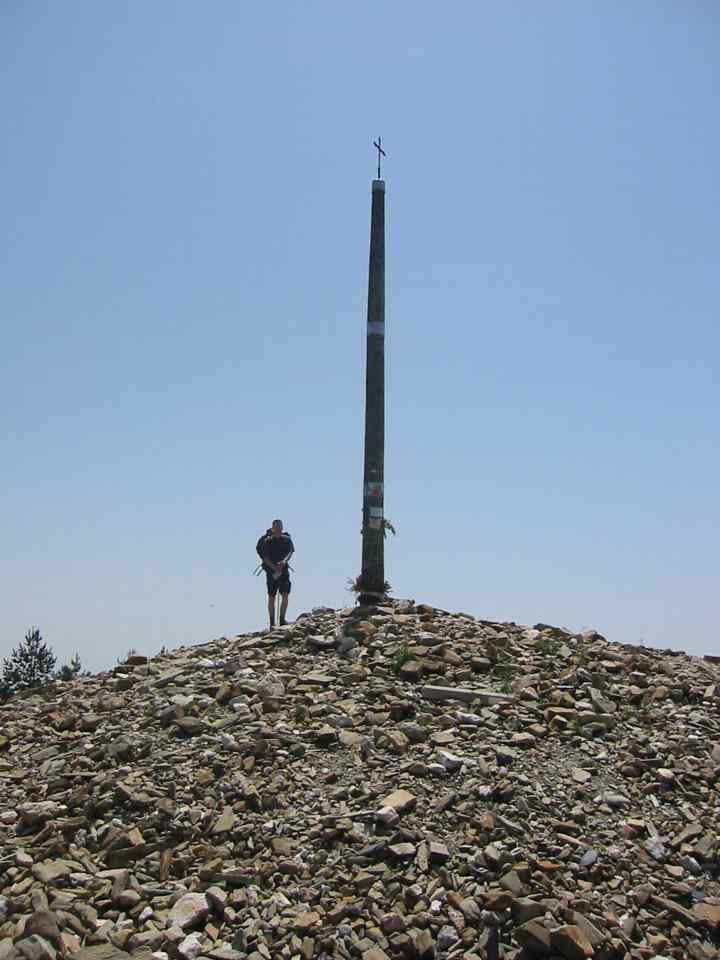
Traditionally, pilgrims brought a stone from their home town, and carried it as far as Cruz de Ferro, the highest point in the Montes de León; here the accumulation of stones and other items forms a sizeable hillock. Tim Moore describes it:
There is something similar at the highest point of the road up from Saint Jean Pied de Port, where the footpath strikes off across the pass:

There are stones here, but there are also socks, insoles, lockets, photographs and other tattered remnants of people's lives. Discarding them may be a pious gesture, but it feels like a piece of folk magic, like the tree of shoes in Heaton Park.
These three images - the column and the two crosses, the two piles of stones and the wire draped with bright scraps of cloth - keep rearranging themselves in different patterns in my mind, pulling in different associations (I haven't even mentioned the Tower of Lives from Chaz Brenchley's Books of Outremer, for example). I try to arrange my pebbles in a logical pattern, but all I can do is gather them together, do my best to balance one on another.
tamnonlinear (thanks to matociquala; and don't miss the pictures!), but they do inhabit the landscape, and provide a fixed point on which to take compass bearings.In the department of the Pyrénées-Atlantiques, columns have been set up every few miles along the Chemin de Santiago. And passing walkers have clearly suffered the impulse to balance stones on top of them.
A little further down the road, another flat raised surface has tempted passers-by to place stones on it:
This variation on the theme strikes my eye very incongruously, because it reminds me of the Jewish convention which places small pebbles on a grave as a token of remembrance; the people who so decked out this Christian cross were more likely to be thinking of the pilgrim habit of leaving a stone at a certain point along the road, as a symbol of the sins which were being removed by the pilgrimage. Somebody appears to be abandoning a larger than average sin at this crossroads.
Traditionally, pilgrims brought a stone from their home town, and carried it as far as Cruz de Ferro, the highest point in the Montes de León; here the accumulation of stones and other items forms a sizeable hillock. Tim Moore describes it:
...I was unsettled by the wind and the disorientating vastness of the prospect, and placed a steadying hand on the wooden pole. Its bottom 7 feet or so were fulsomely decorated with a confounding assortment of apparently significant objects: a foot-long blonde plait, a cycle clip, an enamel saucepan. Up here the stones had given way to more obscure embodiments of contrition, weathered offerings piled about my feet in ephemeral judgement of the conflicting people who did what I was doing, and the conflicting reasons they did it for. A sock, a bra, a jockstrap. The Adventures of Sherlock Holmes. Two postcards of the Virgin; a toy gun and a full pack of Rothmans; boots and shoes and heather. All stacked up around the bottom of the cross's wooden trunk, like someone's crap Christmas.
There is something similar at the highest point of the road up from Saint Jean Pied de Port, where the footpath strikes off across the pass:
There are stones here, but there are also socks, insoles, lockets, photographs and other tattered remnants of people's lives. Discarding them may be a pious gesture, but it feels like a piece of folk magic, like the tree of shoes in Heaton Park.
These three images - the column and the two crosses, the two piles of stones and the wire draped with bright scraps of cloth - keep rearranging themselves in different patterns in my mind, pulling in different associations (I haven't even mentioned the Tower of Lives from Chaz Brenchley's Books of Outremer, for example). I try to arrange my pebbles in a logical pattern, but all I can do is gather them together, do my best to balance one on another.


![[identity profile]](https://www.dreamwidth.org/img/silk/identity/openid.png)
no subject
Date: 2005-06-28 10:57 pm (UTC)I've done the stone pile thing myself. I am used to them as a trail marker system, though. You see them all the time if you hike in the Rockies beyond the more touristy (and therefore well-maintained and -marked) trails, especially once you get above the tree line. They denote the safe route across or through rough terrain. The reason people continue to place the rocks there is based on the idea that, through weather or other accident, a few will fall off periodically. If every passer-by adds his own stone, there will be a continuous rebuilding of the markers.
I didn't know that they were also done in Europe. And the lore is much different. Interesting.
no subject
Date: 2005-06-29 09:24 pm (UTC)The flotsam of Saint Jean Pied de Port reminds me, a bit, of the burial pyres of some of the indigenous tribes of North America. Odd, that.
It reminded me - purely visually - of a tree I'd seen somewhere (Armenia, maybe?) to which local people had tied handkerchiefs, I think because it was believed to grant wishes. Psychologically, it's probably closer to the photos and mementos that the women of the peace camp at Greenham Common tucked into the fence of the air base.
And so on.
It's kind of you to describe my ramblings as "the lore": I'm very aware how rich this subject is, and how incoherent my response to it.
no subject
Date: 2005-06-30 05:56 pm (UTC)